Why Helium and Not Any Other Gas
Helium leak test services are built around a physical property of helium that no other inert tracer gas possesses in the same combination: it is the second smallest atom in the periodic table, with a kinetic diameter of approximately 0.26 nanometres, it is chemically inert and non-flammable, it is present in the atmosphere at only 5.2 parts per million, and it produces a highly distinct mass spectrometer signal. These four properties working together explain why helium became the standard tracer gas for precision leak detection. A leak path that traps nitrogen molecules may allow helium to pass through because the smaller atomic radius navigates tortuous paths in metal or polymer seals that larger molecules cannot traverse. The near-zero background concentration in ambient air means that a mass spectrometer tuned to helium’s atomic mass of 4 generates essentially no false positive signal from the surrounding environment.
The Sensitivity That Mass Spectrometer Leak Detectors Achieve
Helium leak test services using mass spectrometer-based detectors can reliably detect leak rates as low as 1 x 10^-10 mbar litres per second under optimised test conditions. To put this in physical terms, a leak of this magnitude would allow approximately one cubic centimetre of helium at atmospheric pressure to pass through the leak path over a period of more than 300 years. This sensitivity level far exceeds what pressure decay testing, bubble testing, or ultrasonic testing can achieve, making helium mass spectrometry the method of choice for components where even the smallest leakage represents a functional or safety failure.
Practical detection limits in field testing rather than laboratory conditions typically sit in the range of 1 x 10^-8 to 1 x 10^-9 mbar litres per second, accounting for instrument background noise, component outgassing, and test setup variables.
The Three Principal Test Modes and When Each Is Used
Helium leak testing methodology varies depending on the component geometry, the required detection sensitivity, and whether the leak is expected to be inward or outward. Three configurations cover the majority of industrial applications.
Vacuum testing, also called the inside-out or hard vacuum method, evacuates the test component to a high vacuum using a roughing pump and turbomolecular pump combination, then surrounds or floods the exterior with helium. Any helium that passes through a leak path enters the evacuated interior and is drawn to the mass spectrometer detector. This method achieves the highest sensitivity and is used for hermetically sealed components such as pacemaker housings, vacuum chambers, and pressure vessel joints.
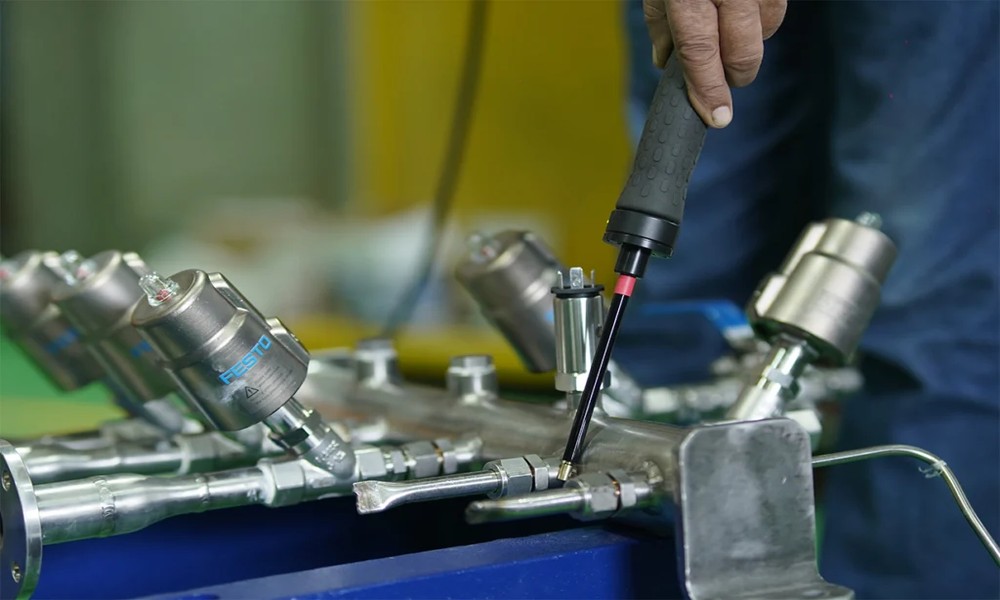
Sniffer testing pressurises the component interior with helium or a helium-air mixture, then uses a handheld sniffer probe connected to the detector to scan the exterior surface for escaping helium. This method is suited to large components where full enclosure is impractical and achieves sensitivities in the range of 10^-7 mbar litres per second.
Accumulation testing encloses the component in a sealed bag or tent, pressurises it with helium internally, and measures the helium concentration inside the enclosure after a defined accumulation period. It suits intermediate sensitivity requirements and large irregular components.
Industry Applications Where No Alternative Method Suffices
Precision helium leak testing is specified in industries where leakage has safety, sterility, or performance consequences that conventional testing methods cannot verify to the required standard. Medical device implants including pacemakers, cochlear implants, and drug infusion pumps must achieve hermetic integrity specifications measured in helium equivalent leak rates, because moisture ingress into the device enclosure causes electronic failure over the device service life. Semiconductor vacuum process equipment must maintain chamber integrity at pressures below 10^-6 mbar to prevent process contamination, and any leak that allows atmospheric gases to enter the chamber at detectable rates causes yield loss in the wafer process.
“Singapore’s advanced manufacturing sector, particularly in medical devices and semiconductor equipment, requires leak testing capabilities that meet the highest international standards,” Singapore Manufacturing Federation noted when addressing the precision engineering sector’s quality infrastructure requirements.
Automotive air conditioning systems, refrigerant circuits in commercial cooling equipment, and LNG storage tank welded joints are further application categories where the consequence of undetected leakage ranges from regulatory non-compliance to safety incident.
Standards Governing Helium Leak Test Procedures
Helium leak test services are conducted in accordance with published test standards that define acceptable test procedures, instrumentation requirements, and pass/fail criteria. ASTM E493 specifies standard practices for leakage testing using mass spectrometer leak detectors. ASTM E498 covers the enclosure method. ASME Section V, Article 10 covers leak testing in pressure vessel applications. MIL-STD-202 and MIL-STD-883 define test requirements for electronic components in defence and aerospace applications. Test reports that reference the applicable standard provide the traceability that customers and their regulators require when reviewing leak test records.
Calibration and Instrument Qualification
Helium leak test services are only as reliable as the calibration state of the detector being used. Mass spectrometer leak detectors must be calibrated against a certified reference leak of known conductance before each test session or at intervals specified by the test procedure. Reference leaks are calibration artefacts with a precisely characterised helium flow rate, traceable to national metrology standards, whose shelf life and stability must be verified. An instrument that has drifted from its calibrated baseline or is operated with an expired reference leak produces results that cannot be defended against customer or regulatory challenge.
Integrating Helium Leak Testing Into Quality Systems
Helium leak test records, including the test mode used, the equipment serial number and calibration status, the test operator identity, the test conditions, and the measured or estimated leak rate, form part of the component’s quality record. For medical device manufacturers operating under ISO 13485, these records are part of the device history file required by the standard. For aerospace and defence manufacturers under AS 9100, leak test records contribute to the objective evidence of product conformance. Helium leak test services delivered with full documentation support quality systems requirements as directly as they support engineering confidence in the product.